
6 Mins
Published: May 29, 2026



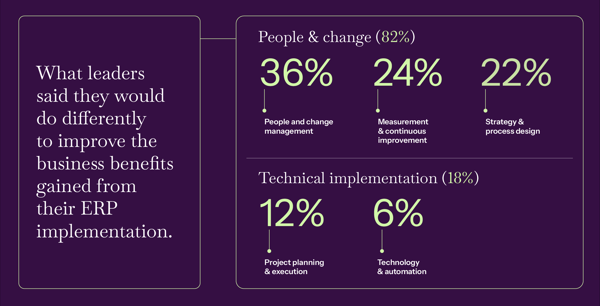
Enterprise resource planning (ERP) systems promise streamlined processes, greater efficiency, and higher productivity. But these promises only uphold when teams strategically align and optimize processes before automating them in the new system.Strategy and Process Design account for 22% of what 1,618 ERP professionals would do differently to improve ERP success—the third-largest category. That’s because automating broken processes leads to faster failures and rarely delivers benefits without heightening operational friction. Without executive clarity on what success means, implementation teams optimize for technical completion while business leaders expect transformational outcomes.
Delivering value, not just the ERP system, requires alignment, governance, and a shared direction for the way forward.
What leaders said they would do differently to improve the business benefits gained from their ERP implementation
ERP system vs. value delivery
ERP programs are often judged by whether the system goes live, but that’s not what the business ultimately cares about. Executives must stay anchored in value delivery, not just technical implementation, to deliver the business transformation organizations want.
Revisiting value delivery throughout the ERP implementation
When supporting ERP deployments, I see senior leaders start with a strong business case that clearly articulates value, benefits, metrics, and people impact. And then, once the business case is presented and approved, teams rarely revisit it. But when leaders archive the business case and set it aside, failing to keep it top of mind, executives and steering committees can unintentionally shift their focus from value realization to technical progress. Leaders can and should regularly revisit the ERP implementation business case, asking questions like:
- What is our business case?
- Which value assumptions are still valid?
- Are there any benefits we want to achieve that are currently at risk?
- What can we do to limit risk or assess the trade-offs of failing to achieve these benefits?
Equipping sponsors to communicate the story for change
In addition to revisiting the ERP business case, emphasizing and ensuring the sponsor understands how to be an effective sponsor, and can communicate the value and business benefits, helps keep the goal top of mind. In practice, this looks like:
- Conducting a sponsor briefing at the beginning of an ERP deployment and reiterating the importance of communicating the story for change
- Engaging the sponsor coalition around the value story and business benefits
- Challenging the team when decisions drift toward technical implementation allows sponsors to naturally ask, “Are we on track to deliver the value we promised?
Monitoring change alongside project delivery
Finally, strong governance is the practical mechanism that can help teams prioritize value delivery over system implementation success. In ERP deployments, we often see a program management office (PMO), and it’s critical to have a change management office (CMO) integrated alongside them. The integration of project management and change management helps teams assess not only the project’s progress, but also the people side of change, keeping the people impact and desired benefits at the forefront of the work.
The cost of misaligned ERP programs
When I worked on an SAP deployment for a large energy company, the ERP system relied heavily on another initiative related to rationalizing the entire application landscape. The applications were supposed to be ready before the SAP arrived, but the sequencing between the two programs was misaligned. Meetings between the sponsors and program leaders were infrequent and lacked a structured approach to shared risks, dependencies, or success criteria.
The ineffective communication between sponsors led to compounding risks, including:
- A lack of shared knowledge around decommissioned and improved applications, leading to interface design that didn’t match reality, and increasing costly ERP system configuration rework
- Misaligned program roadmaps leading to missed milestones due to unaccounted for interdependence
- Technical escalation issues and extended life of legacy applications, increasing cost for an extended period
- Financial impact due to ERP implementation delay
- Temporary technical workarounds to bridge the gap between the planned and actual states, adding further cost and complexity
- Widespread confusion and change fatigue as a result of mixed messaging from the two sponsors across the multi-country, multi-entity environment
When organizations lack a tight connection between highly interdependent programs, confusion and risks compound, making or breaking the success of an ERP initiative. Without effective coordination, these misaligned programs created a cascade of escalations, increased risk exposure, higher overall program costs, and significant people impact.
Preventing misaligned ERP programs
From a governance perspective, this example illustrates the cost of misalignment, which executives can prevent through:
- Clearly defining ERP success criteria and stating that ERP success is conditional on the outcome of interdependent programs
- Unifying or tightly aligning interconnected programs as one interdependent transformation with a shared or overarching sponsor
- Centralizing governance through joint steering committees focused on shared risks and combined success metrics, rather than running the programs in silos
Transformational change outcomes are much harder to achieve when misalignment creates unwanted risks and costs, hindering the success of an ERP implementation. ERP programs dependent on other initiatives face compounded risk when program leaders aren't aligned.

Defining ERP success before go-live
Business leaders don’t invest in ERP systems to achieve technical implementation without change; they expect transformational outcomes. Emphasizing the importance of a shared story for change before go-live is essential to steering the program toward the outcomes the organization cares about.
Here’s how we approach workshopping the story for change and aligning on success:
Align on the business context and case for change
Before configuration starts, executive sponsors and key stakeholders need a shared understanding of why the organization needs the ERP now. This looks like asking the questions:
- What is the organization’s current position in the market and competitive landscape?
- What challenges is the organization facing internally and externally?
- What is the current stance on the evolution of the company and the market?
- Why is an ERP the right solution to these challenges?
- Where do you want to go with the new ERP?
- What past successes should we celebrate before beginning this transformation?
Without this context, teams risk treating the ERP as a technology upgrade rather than a business-critical transformation. Acknowledging past successes also helps paint the picture that the foundations are in place to support this new initiative.
Define ERP success criteria and measures
At Prosci, we use the Prosci Change Triangle (PCT) Model, one of the two foundational models of the Prosci Methodology, to help senior leaders, steering committees, project managers, change managers, and other key stakeholders align on a shared definition of success. We encourage them to consider the desired situation and imagine the change as a success years down the road. We ask:
- What will we celebrate at the end?
- What does success look like?
- What key metrics will we measure to show that the ERP implementation is successful and achieving the benefits the organization wants to realize?
- What key benefits and value will exist?
This exercise encourages leaders to workshop and agree upon a consistent story for change while also considering how to manage the transformation operationally. The goal is to find common ground that shapes the global story around the ERP deployment, the overarching vision, and key success metrics.
Defining success before go-live has to be done really well in advance, which is not always the case for organizations kicking off ERP implementations.
Determine standardization balance
In global ERP programs, executives also need to make an explicit decision about the balance between standardization and local adaptation. In practice, a common pattern is aiming for roughly 80% standardization and 20% local adaptation. The 80% represents the harmonized consistency that drives efficiency and comparability across different parts of the organization. The remaining 20% is a governed space for local adaptation, such as country-specific applications, regulations, or deeply embedded systems that cannot change on the same timeline.
When organizations drift toward 80% local and 20% standard, they erode the enterprise value case and recreate complexity. When they refuse any local flexibility, they fuel resistance and workarounds. Treating the 80/20 balance as a strategic value decision, grounded in the business case, helps leaders protect both global harmonization and local realities.

Process optimization before ERP configuration
Our research shows that process optimization before configuration prevents costly rework, whereas automating broken processes leads to faster failures.
Reconfiguration after go-live costs substantially more than proper design beforehand. In the SAP deployment for the large energy company mentioned above, the misaligned interdependence between the application program and the lack of clarity around that body of work led to some rework of the ERP system configuration.
When processes are unclear, inconsistent, or misaligned with the business strategy, a new ERP system merely exacerbates them. Optimizing and standardizing core processes before configuration, grounded in the business case, success criteria, and 80/20 standardization decisions, ensures that what you automate reflects the way the organization intends to operate going forward for the best results.
Executive action for strategic alignment before ERP configuration
Whether you’re preparing to launch an ERP program or trying to realign one that’s already in motion, consider:
- Revisiting your business case governance – Don’t let the ERP business case be a one-time approval that disappears after. Use it as a standing reference to revisit value assumptions, assess at-risk benefits, and consciously decide on trade-offs.
- Advocating for cross-program alignment – When ERP success relies on related initiatives, manage them under a shared governance umbrella. Align sponsors, integrate roadmaps, and create joint oversight focused on shared risks and success metrics. Treating these programs as one transformation reduces rework, prevents compounded risk, and preserves the path to value while making the messaging more explicit and clearer for the impacted groups.
- Balancing standardization with local realities – Decisions about the 80% standard / 20% local adaptation balance are value choices. Ground these decisions in the business case and success criteria, and reinforce them consistently to avoid scope creep, confusion, and resistance.
When executives take these actions, ERP programs are no longer driven primarily by technical milestones. Instead, they are guided by clear definitions of success, integrated governance, and disciplined attention to the people that ultimately determine whether value is realized.