Importance of change management during ERP implementations
Organizations invest millions of dollars in ERP systems, assuming the project's success depends solely on the technology. Research from Prosci’s Unlocking ERP Implementations study tells another story: human factors matter 6x more than technical factors in improving ERP benefits. This finding highlights the importance of change management during these implementations.
Human factors include sustained investment in training, stakeholder engagement that fosters ownership, structured change management approaches, improved communication and cross-functional collaboration. Organizations that invest in people during ERP implementations achieve substantially better outcomes than those that don’t.
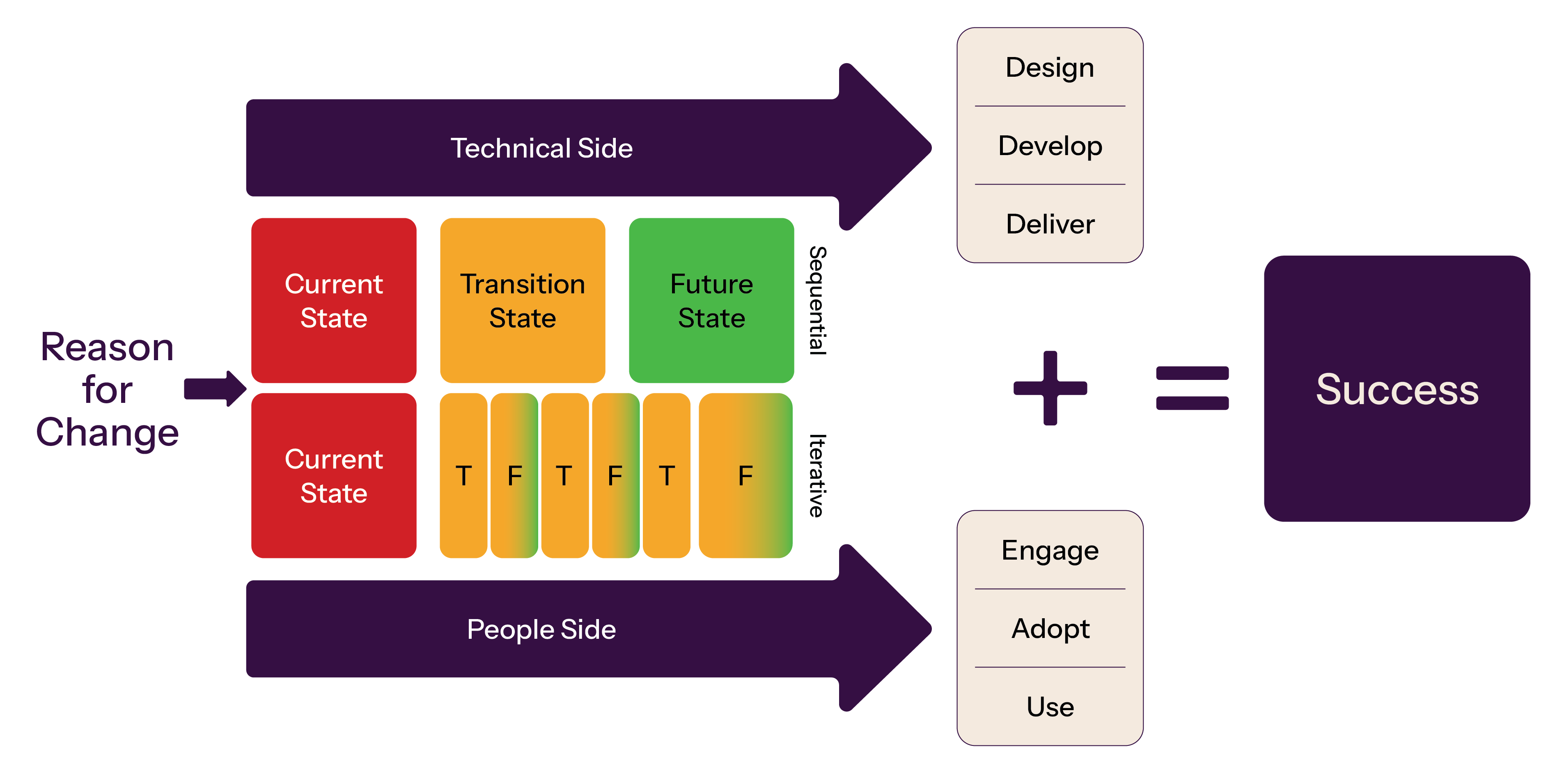
ERP change management plays a critical role in influencing whether an ERP implementation delivers lasting value or falls short. While the technical side of implementation focuses on configuring the system through project management, change management focuses on preparing people to adopt the new ERP and adapt their ways of working to it. Both are necessary for individuals, teams, and organizations to move from the current state to the desired future state and use the updated ERP systems in their daily work.
Prosci Unified Value Proposition
Benefits of implementing an ERP system
Successful ERP implementations require substantial buy-in across an organization, but the benefits are often worth the hurdles. Organizations that successfully implement ERP systems usually experience the following benefits:
- Centralized data and improved visibility – ERP systems consolidate data into a single source of truth, enhancing transparency and reducing reliance on siloed tools and manual processes.
- Process automation and efficiency – ERP software can standardize and automate core processes while reducing manual effort, provided process design is incorporated into the work early on.
- Better decision-making with analytics – With integrated data and reporting capabilities, ERP systems enable leaders to make faster, well-informed decisions to support planning, forecasting and performance management.
- Customer experience improvements – The right ERP system and processes can help organizations respond more quickly and consistently to customer needs, improving the overall customer experience.
- Reduced operational costs – Over time, ERP implementations can lower costs by eliminating redundant systems, improving resource utilization, and reducing errors resulting from manual work.
Despite the benefits of a successful ERP implementation, organizations need to be aware of the challenges that can lead to ERP implementations failing. Employees develop habits around the systems they use daily across various business functions. Changing the tools that shape daily habits and workflows can prove particularly challenging when employees resist. The interconnectedness of cloud ERPs and resistance to change can create an environment that slows progress.
Additionally, data quality issues can undermine user confidence in the system, further slowing progress and successful change. And when the scope and expectations of the ERP implementation work are not carefully managed, budget overruns can occur, turning an already significant investment into an even costlier one.
Phases of an ERP implementation plan
An ERP project unfolds through multiple phases, each designed to achieve specific technical and people outcomes. A structured ERP implementation plan helps teams manage complexities, reduce risk, and maintain momentum through what is often a long implementation journey. The ERP implementation lifecycle generally follows six phases:
Phase 1: Preparation
The initial phase of an ERP implementation involves defining the project scope, identifying stakeholders, and assessing your organization’s readiness for change. It also includes selecting the right ERP vendor and solution that aligns with your business goals.
Prosci’s Unlocking ERP Implementations study revealed that more than one-fifth of experienced practitioners recommend aligning technology with business needs from the beginning. Alignment involves process optimization, strategic alignment, and thoughtful customization. Aligning ERP system goals with business strategy alignment early is critical to the success or failure of the work.
In this phase, it is critical to gain support from primary sponsors and key stakeholders. Engaging leadership and securing commitment are essential to ensuring the necessary support for change management is in place.
Phase 2: Planning
During the planning phase, teams create detailed project plans that include timelines, resource allocation, and risk assessments. Importantly, defining success criteria and establishing a governance structure are imperative for monitoring and measuring progress along the way.
Expert practitioners in Prosci’s Unlocking ERP Implementations study suggest taking the following steps to build a solid foundation for their implementations during this phase:
- Planning better to prevent downstream issues, including prioritizing realistic scheduling to reduce unwarranted timeline pressure
- Starting implementation activities earlier to leverage strategic timing
- Increasing investments and funding to achieve success instead of compromising on efforts that inevitably reduce value realization
- Supplementing internal capabilities with external consultants, and setting aside budget for the necessary level of expertise required
Phase 3: Execution
During the execution phase, process redesign, data migration and configuration occur. As your organization builds the ERP system, change management activities help translate technical progress into meaningful messages for the organization, reinforcing what is changing and why. Ongoing communication and engagement are essential to prevent uncertainty and resistance from growing.
Prosci’s Unlocking ERP Implementations study highlighted the importance of comprehensive approaches that connect change management to training, stakeholder engagement, and communication. Highlighting role-specific benefits and how upcoming changes help individual contributors do their jobs better increases relevance over generic messaging about the technology transformation.
Phase 4: Testing
Before going live, organizations conduct rigorous testing on the ERP system to ensure it functions as expected and meets business requirements. Testing validates that the ERP software is functioning as intended, but it also provides the opportunity to involve employee user groups.
Employee feedback is essential for identifying areas of concern and making necessary adjustments. According to Prosci’s research, formal feedback mechanisms are critical to continuous improvement and value realization. This includes:
- Creating systematic feedback channels to hear from a representative group of voices, not only the loudest
- Gathering feedback from various stakeholders who are willingly involved in the ERP implementation, rather than forcing feedback
- Using early feedback to shape design and post-implementation feedback to drive optimization
Phase 5: Go-Live
Go-live marks the transition from legacy systems to the new ERP system. The go-live phase may involve a phased rollout or a big-bang approach, depending on the organization’s strategy and the project's initial goals.
Change management during go-live focuses on reinforcing readiness and providing stability. Clear, timely communication helps employees understand what to expect in the first days and weeks, where to find help, and how issues will be addressed. Leaders and sponsors play an essential role by visibly supporting the ERP, reinforcing priorities, and acknowledging the effort required to adapt to new processes.
Training programs and support processes are critical at go-live. Just-in-time training, accessible documentation, and responsive support channels help users build confidence as they begin working in the system.
Phase 6: Post-implementation review phase
Many organizations treat go-live as the finish line of an ERP implementation project. But our Prosci’s Unlocking ERP Implementations findings suggest that these organizations misunderstand when ERP value materializes. Go-live is undoubtedly a significant project milestone, but certainly not the end of the road.
After go-live, focus shifts to optimization. This phase involves evaluating the implementation process, measuring success against defined metrics, and identifying areas for improvement. Gathering employee feedback is critical as users begin to use the system regularly and identify bottlenecks and process improvement opportunities. This information informs future improvements and helps organizations sustain the change in the long term.
Best practices for successful ERP implementations
The following best practices help organizations reduce risk, boost adoption, and increase the likelihood that the ERP system delivers long-term value.
Create a strong project team
A well-structured implementation team brings together business leaders, subject matter experts, representation from core business units, and external expertise, including change management consultants or in-house experts. Clear roles and accountability help the team move efficiently through each implementation phase while ensuring alignment with business priorities. From the highest levels of leadership to frontline employees, an entire system of people within the organization must be involved in the project and support the transition.
Focus on process improvement, not just technology
An ERP project offers an opportunity to rethink and improve how work gets done, rather than simply replacing legacy software and automating inefficiencies. Focusing on process optimization emphasizes streamlining workflows before configuring technology rather than forcing software to match flawed workflows. Participants in Prosci’s Unlocking ERP Implementations study warn against leaning into a technology-first approach, stressing that reconfiguration after go-live costs substantially more than investing time in proper design and process evolution upfront.
Prioritize change management early
In our Unlocking ERP Implementations study, the largest category of recommendations to improve ERP benefits was People and Change Management, at 36%. The value of prioritizing and budgeting for change management in ERP implementations cannot be overstated. Structured change management programs drive value realization and ensure organizations properly address training, stakeholder engagement, and communication.
Keep customizations minimal
Excessive customization increases project complexity, cost, and timeline risks. Focusing on standard ERP functionality where possible simplifies the implementation and makes initial training and adoption easier for users. That’s not to say organizations shouldn’t leverage ERP systems to their full potential. Instead, organizations should start by implementing basic functionality, knowing that the work doesn’t end at go-live. Prioritizing continuous improvement post-go-live offers your organization the opportunity to add customizations down the road.
Communicate continuously with stakeholders
When stakeholders and employees don’t understand the reasons for ERP transformation, skepticism can grow, slowing adoption and eroding momentum. A structured change management approach builds awareness through targeted communications that clearly outline the vision, benefits, and objectives. Transparent messaging that connects technical milestones to key business outcomes keeps everyone aligned and invested in the ERP implementation and how it supports organizational goals.
Use phased rollouts when beneficial
A phased rollout approach can help organizations reduce disruption by spreading change over time and lining up sufficient support for each phase. Instead of introducing all functionality at once, phased implementations allow organizations to focus on specific processes, learn from the experience, and adjust plans accordingly. This approach can be particularly beneficial in large organizations with limited change experts and time constraints.
Invest in ongoing support
There’s a common misconception that go-live is the finish line of an ERP implementation. But our research suggests that while go-live is a critical technical milestone, it’s not the end of the work and should instead be viewed as the starting line. Ongoing support, including systematic feedback channels, drives continuous optimization, recognizing that value realization extends beyond technical deployment. This helps organizations address usage gaps, refine processes, and ensure ERP system capabilities grow over time rather than stop at go-live.
ERP implementation example
When an international entertainment company engaged Prosci, they were navigating a complex, multi-year ERP rollout after previous large-scale change initiatives had fallen short. The organization had grown from 500 to 1,200 employees in a short time, and the scale and complexity of the change demanded a structured approach to the people side.
Prosci provided change management consulting, role-based training, and an Enterprise Change Management License — integrating change management with project management from the start and building change capability across the organization throughout the implementation lifecycle.
The outcome: an 86% improvement in project success and 1,200 new champions for change across the enterprise.
Read the full International Entertainment Company success story.
Evaluating ERP implementation success
Assessing the success of an ERP implementation requires looking beyond technical deployment and analyzing whether the system is delivering meaningful business value and people outcomes. These metrics are essential for understanding how your ERP software is impacting your organization:
- User adoption rate – How many employees actively use the ERP system? High ERP adoption rates indicate that users are integrating the new system into their daily workflows, which is crucial for realizing its benefits.
- Return on investment (ROI) – A positive ROI confirms that the ERP is delivering value and operational benefits, ideally justifying the financial investments. ROI often includes cost savings, productivity gains, and improved decision-making.
- Process efficiency – Assessing whether key workflows are faster, more consistent, and streamlined is crucial for ensuring the ERP system doesn’t merely automate inefficient processes.
- Error rates and issue resolution time – Declining error rates and faster resolution times often indicate growing confidence, reliability, and maturity in ERP system use.
- Employee satisfaction and engagement – Employee feedback helps organizations gauge how people feel about the ERP system's impact on their work. High levels of employee satisfaction correlate with greater system adoption and utilization, ultimately leading to improved organizational performance and visible benefits for employees.
ERP implementation FAQs
What is the ERP implementation process?
The ERP implementation process includes selecting, configuring, testing, and deploying a new ERP system across an organization. An ERP implementation unfolds through multiple phases, including preparation, planning, execution, testing, go-live, and post-implementation review and improvements. The ERP implementation process is extensive and ultimately moves organizations from their current state to their desired future state, with the new system in place and employees successfully adopting it.
How long should an ERP implementation take?
The length of an ERP implementation varies based on organizational size, scope, and complexity. Often, ERP implementations are multi-year-long. While there are no right or wrong answers regarding implementation timing, realistic scheduling is critical. Unnecessary schedule pressure might seemingly accelerate delivery, but it can actually delay value realization and negatively impact adoption. Planning conservatively is necessary for delivering working systems and changed behavior.
How much does an ERP implementation cost?
The total cost of an ERP implementation varies with organizational size, scope, complexity, and, most importantly, adequate resourcing, often running into the millions by the time the project is complete. Most ERP implementations concentrate the majority of budget and resources on technical activities, including system configuration, data migration, integration development, and technical testing. But your budget must cover not just the cost of the software, but also the cost of preparing your people and organization to use it. In addition to technology, ERP implementation upfront costs should include process documentation, internal resources, and change management expertise.
When is an ERP implementation complete?
Traditionally, organizations considered ERP implementations complete at go-live. However, organizations treating go-live as the finish line misunderstand when ERP value materializes. An ERP implementation is not complete at go-live; rather, this is one of many milestones to work toward. The commitment to continuous improvement and ongoing feedback might suggest that an ERP implementation is never fully complete, but always a work in progress with many celebratory milestones along the way.
Lead a successful ERP implementation with Prosci
The return you recoup from your ERP implementation depends heavily on your ability to navigate change successfully. According to Prosci’s Unlocking ERP Implementations, human factors matter 6x more than technical factors in improving ERP benefits, highlighting the importance of change management during these implementations.
Don’t settle for an ERP implementation that merely gets deployed. At Prosci, we have the knowledge, expertise, and comprehensive solutions to ensure your ERP implementation succeeds and delivers the benefits your organization deserves. Contact us to get started.
Make Your ERP Implementation a Success With Prosci
The return you recoup on your new ERP Implementation is highly dependent on your ability to successfully navigate change. Contact Prosci today and transform your organization’s capacity for change with our advisory services.