
7 Mins
Published: May 28, 2026



Organizations are moving fast to deploy AI tools, but don’t have the right frameworks and strategies to measure and understand whether their deployments are adding value.
In the absence of a coherent measurement framework, leaders have no reliable way of knowing what’s happening or where they need to support employees. The instinct is to track visible, quantifiable data points, such as system logins, but those metrics measure overall activity, rather than changed behavior.
Prosci research on AI adoption across the enterprise shows that 38% of AI adoption challenges stem from user proficiency issues, making it the greatest barrier between deployment activity and actual adoption. System logins could demonstrate employee use of the system, but actual usage might go overlooked without the right framework to capture these human challenges.
For organizations to truly measure AI success in terms of organization-wide adoption, they need measurement frameworks that account for the human side of change.
The measurement problem most organizations are getting wrong
The AI adoption metrics that are easiest to report and track are those that indicate deployment completion, not behavioral adoption. When enterprise AI initiatives stall, most organizations evaluate the metrics most readily available to them rather than those that reveal the barriers requiring attention.
The measures most organizations rely on during AI rollouts include:
- License provisioning and access rates – The number of employees who have access to an AI tool.
- Training completion rates – The percentage of employees who complete assigned onboarding and training sessions.
- Feature utilization counts – The frequency with which employees are opening or interacting with various aspects of the AI tool.
- Self-reported satisfaction scores – Employee ratings of their experience with the tool or AI training.
These measures point toward activity, not the behavioral differences that drive long-term value realization for organizations. Enterprises must distinguish between leading and lagging indicators in AI adoption: access, training, and feature usage can signal early momentum, while behavior change, workflow integration, and business impact reveal whether adoption is leading to transformation. The measures that actually indicate AI adoption success include:
- Behavior change – Whether employees change their behavior and adopt AI tools or resist them entirely.
- Proficiency over time – Whether employees get faster, more confident, and more independent in their use of AI tools.
- Workflow integration – Whether employees embed AI into how they do their work or view it as a parallel, optional step alongside their workflows.
- Reliability and trust – Whether AI use holds when employees feel under pressure, or they revert to previous habits when the stakes are high.
- Role-specific capability – Whether employees use AI in meaningful ways unique to their specific function.
Organizations that focus on deployment metrics increase their risk of “shelfware.” “Shelfware” risk refers to licensed tools that go unused because they fail to measure actual adoption. This is not a technology failure but rather a measurement issue.
Moving from deployment-only to actual adoption metrics means acknowledging that tool measurement alone isn’t enough. The measures that matter most include whether each individual uses AI and whether they change their behavior as a result.
Start with a shared definition of AI success
Organizations first need to define what AI success looks like at the organizational, team, and individual levels. AI adoption is not a one-size-fits-all journey; it’s a multifaceted process that requires different approaches at each level.
In our AI adoption research, we found that different organizational levels evaluate the impact of AI differently. Executives skew toward strategic and operational outcomes, like cost savings and new growth opportunities. Team leaders balance tactical needs with strategic requirements, caught between delivering results and meeting organizational expectations. And frontline employees are motivated by practical applications, such as improvements to tasks and response times.
This misalignment explains why many AI transformations stall and fail to achieve the results they expect. Leaders drive strategic implementations while frontline workers want practical solutions.
To address this gap, organizations must define success statements at each level before measurement begins, with these focus areas in mind:
- At the organizational level, success statements tie to strategic outcomes, including productivity, competitive positioning, cost efficiency, or risk reduction.
- At the team level, success statements tie to outputs and workflows, including the quality of the work product, delivery speed, and reduced rework.
- At the individual level, success statements tie to task-level capability and confidence, including whether employees can use a tool independently, effectively, and without friction in their jobs.
In practice, this kind of multi-level structure can function like a balanced scorecard, enabling enterprises to evaluate AI success across organizational, team, and individual dimensions rather than relying on a single adoption metric. Without clearly defined success statements at every level, organizations are left wondering where barriers lie and are unable to address them.

A four-layer measurement framework for organization-wide AI adoption
Most AI measurement frameworks stop at the surface. They capture what the technology is doing without ever examining whether the people using it have changed how they work and whether the organization has built the conditions for that change to last.
The Four-Layer AI Adoption Measurement Model below organizes AI adoption into four distinct layers, each building on the one before it. Taken together, these layers can serve as a balanced scorecard for enterprise AI adoption, helping leaders track both leading and lagging indicators across activation, behavior change, business impact, and governance.
Layer 1 – Activation and access
Activation metrics are the foundation of The Four-Layer AI Adoption Measurement Model. They answer questions like: Are employees using the AI tool? How many active users are there across the organization? What is our license utilization.
These metrics serve as a baseline. A significant gap between provisioned licenses and active users is an early warning. Consistently low activation rates can indicate an awareness or access problem, as employees may not know the tool is available, may not understand how it applies to their role, or may face technical barriers.
The risk of treating activation metrics as primary success indicators is that they only describe activities, not real value. When activation is the headline metric, organizations routinely declare success when the deployment project closes, long before any evidence of behavior change exists.
Layer 2 – Behavioral change and proficiency
Behavioral change is the layer that determines whether the investment in AI is producing value or producing the appearance of value. It answers questions like: Are employees working differently? Do they use AI tools effectively in their real workflows?
Prosci’s study, Keys to Unlocking AI Adoption, revealed that user proficiency is the single largest challenge in AI adoption, cited by 38% of respondents, more than double the rate of technical integration issues (16%) and organizational adoption challenges (15%). Organizations are not primarily failing at AI because the tools don't work. They are failing because employees lack the proficiency to use them effectively, and enterprises rarely measure that gap with enough specificity to act on.
Top Challenges of Enterprise AI Adoption
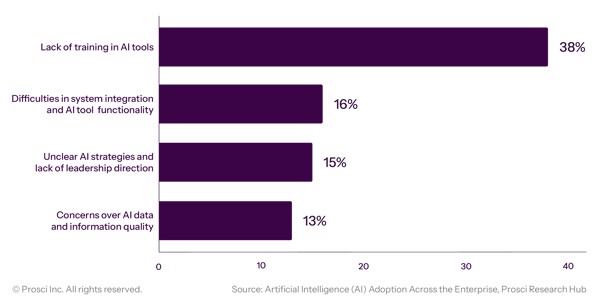
Organizations can’t infer proficiency from training completion alone. Enterprises need to define proficiency by role, track it over time, and assess it against the actual tasks that matter for each function. Doing so helps organizations overcome significant barriers through the lens of Prosci’s ADKAR® Model: Knowledge and Ability barriers.
Layer 3 – Business and operational impact
Business and operational impact metrics are the outcomes that most organizations care about and that AI investments aim to deliver: quality improvements, cycle time, throughput, and stakeholder satisfaction.
Prosci research on how team leaders measure AI success paints a clear picture: AI success indicators are dominated by performance improvements (54%), stakeholder satisfaction (13%), and time savings (12%). The challenge is that organizations often set targets for these outcomes at the enterprise level without tracing them back to the role-level behaviors that drive them. A cycle time improvement happens because a specific group of employees changed how they work, consistently and competently enough to move a measurable outcome.
Ultimately, these metrics depend on achieving success in the first two layers.
Layer 4 – Culture, governance, and trust
The fourth and final layer is the most underserved in most measurement frameworks, and increasingly, the one with the highest strategic stakes.
Prosci research draws a clear line between organizations that are succeeding in AI implementation and those that are struggling: the differentiators are not primarily technical. Prosci identifies leadership commitment and clarity as the #1 differentiator between successful and unsuccessful AI adoption, with a +1.65 difference. High-performing organizations score +1.29 in transparency and clarity around AI strategy, while low performers lag at -0.54, creating a communication vacuum that undermines trust.
Understanding employee trust in AI outputs, clarity around AI usage and prohibited use cases, governance compliance, and Shadow AI visibility (unauthorized tool usage) tell leaders whether the conditions for sustained, organization-wide AI adoption are in place.
Segment your measurement by role, not just by tool
Prosci's research across 1,107 participants found measurable differences in how AI is perceived, trusted, and used across organizational levels. Executives report higher trust (+1.09) and ease of use (+1.19) than frontline workers (+0.33 trust; 0.78 ease of use). One-size-fits-all deployments and measurement frameworks mask friction if you don’t measure them meaningfully.
A simple, role-based segmentation model for executives, team leaders, and the frontline can address some of these gaps. Here’s an example:
- Executives – AI is informing strategic decisions. Behavioral indicators include: using AI-generated analysis as input to planning and resource allocation; leaders actively model AI use in visible ways; and governance decisions reflecting direct familiarity with how employees use AI tools across the organization.
- Team Leaders – Teams embed AI into their work delivery. Behavioral indicators include: AI outputs are being reviewed, applied, and quality-checked as part of the standard workflow; the team leader is actively coaching proficiency rather than assuming training has handled it; and AI use is consistent across the team rather than concentrated in a few enthusiastic individuals.
- Frontline – AI use is confident, independent, and provides task-based value in the specific tasks that define the role. Behavioral indicators include: the employee can use the tool without prompting or assistance for workflows, proficiency is improving over time, and the employee can evaluate AI outputs critically.
Segmenting measurement by role does not require a separate framework for each tier. It requires that the success definitions established at the outset (organizational, team, and individual) are reflected in how the organization collects, reports, and acts on data.
What change management has to do with AI success
The organizations measuring AI success most rigorously are treating adoption as a change management challenge, not just a technology deployment. That distinction has measurable consequences. Prosci's Best Practices in Change Management research found that projects with excellent change management achieve their objectives 93% of the time, compared to 15% for projects with poor change management. That’s the difference between crossing the deployment finish line and creating lasting behavioral change.
Prosci’s ADKAR Model — Awareness, Desire, Knowledge, Ability, and Reinforcement — offers a useful diagnostic for practitioners to map measurements to individual adoption stages and distinct interventions to overcome barriers. The specific failure most AI initiatives share is the gap between Knowledge and Ability. Training completion indicates that employees received information, not whether they can apply it independently, under real conditions, in the workflows that matter most. Understanding how to spot these gaps and deploy the right change management strategies to close them sets organizations that succeed apart from those that don’t.
Prosci’s ADKAR Model

Organization-wide AI adoption requires measuring the human side of change
The organizations that will get the most from AI are not necessarily the ones that moved fastest or spent the most money on high-quality tools. They are the ones building the discipline to know — with specificity, at every level of the organization — whether their people are actually changing how they work, and what to do when they aren't. That’s the power of change done right.